Fourier Transformation
Let us consider periodic function with some period \(L>0\). Due to the fact that any linear combination of two periodic function with the same period is again a periodic function, the space of the periodic functions is mathematically a vector space. It is thus natural to seek for a basis in the space of periodic functions.
The archetypical periodic functions are the sine and cosine functions, that can be together compactly represented in the form of a complex exponential:
$$\varphi(x)=\exp(\mathrm{i}kx),$$
where \(k\) is some real parameter.
If we now impose the periodicity with the period \(L\) on the complex exponential we obtain the following relation which restricts the possible values of \(k\):
$$\varphi(x+L)=\varphi(x)\rightarrow\exp(\mathrm{i}kL)=1.$$
This relation will be full filled only for a discrete set of \(k-\)values that are defined by the relation:
$$k_{n}L=2\pi n\quad n\in\mathbb{Z}.$$
In this a discrete set of complex exponential functions all with the fundamental period of \(L\) can be constructed:
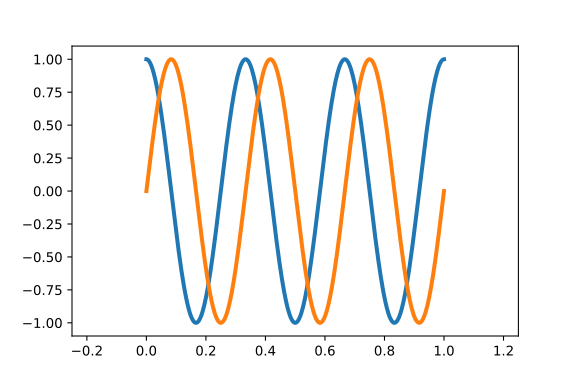
$$\varphi_{n}(x)=\exp\left(\frac{\mathrm{i} 2\pi n}{L}x\right)\quad n\in\mathbb{Z}$$
from ipywidgets import interact
import ipywidgets as widgets
L = 1.0

def plot_exp(n):
    x = np.linspace(0, L, 500)
    y= np.exp(2.0j*np.pi*n*x/L)
    plt.xlim((-0.25, 1.25))
    plt.plot(x, y.real, lw = 3.0)
    plt.plot(x, y.imag, lw = 3.0)

interact(plot_exp, n=widgets.IntSlider(value=1, min=1, max=10, step=1))
The plot for \(n = 3\) is shown here: